| 63 This
View of Life |
Natural History 5/97 |
|
process in Manuscript F (in the Institut de France):
Because the center of the natural gravity of the earth ought to
be in the center of the world, the earth is always growing lighter
in some part, and the part that becomes lighter pushes upwards, and
submerges as much of the opposite part as is necessary for it to join
the center of its aforesaid gravity to the center of the world; and
the sphere of the water keeps its surface steadily equidistant from
the center of the world.
Leonardo must then find a general mechanism for lightening one hemisphere,
while making the other heavier--and he succeeds with two principles,
both based on erosion by water: one mode operating in the earth's interior,
the other at
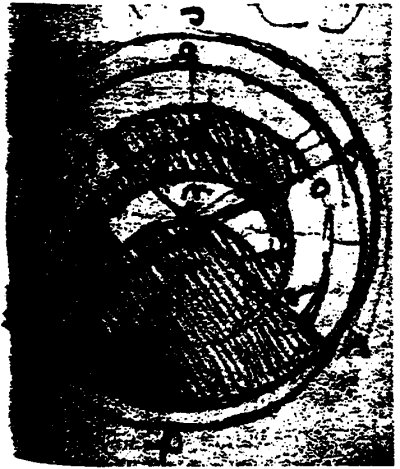 |
Leonardo's
mechanism for the rising of mountains: the upper hemisphere becomes
lighter when a large mass of earth falls to the center of the planet. |
the earth's surface. In the interior, internal veins of water carve
out caverns, which eventually become unstable. Their tops finally collapse,
and enormous blocks of lock fall all the way to the center of the world.
There, the blocks distribute themselves about the center with approximately
equal volume in each hemisphere--thus adding weight to one