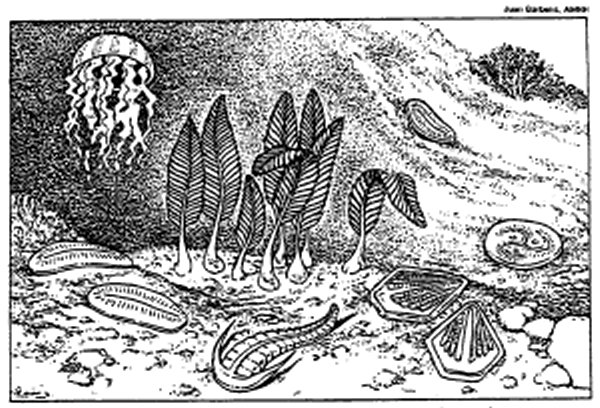
 In conventional reconstructions of Ediacaran animals, they are depicted
as the ancestors of modern forms--jellyfish, soft corals, and
worms.
In conventional reconstructions of Ediacaran animals, they are depicted
as the ancestors of modern forms--jellyfish, soft corals, and
worms.
from A View of Life, by S. E. Luria, S. J. Gould,
S. Singer
represent a coherent fauna strikingly different from any modern counterpart
in basic design.
Following a progressivist bent, I might be gratified that life's first
"try" used the simpler of two solutions--a change in body
shape rather than an evolution of complex internal organs. Be that as
it may, the important point remains that if Seilacher is right, the Ediacaran
fauna represents a different, unique, and coherent experiment in organic
architecture--not a set of precursors for modern animals. To emphasize
this discontinuity, the first Paleozoic fauna with hard parts, the so-called
Tommotian assemblage, is filled with tiny tubed, coiled, and cap-shaped
creatures bearing precious little similarity to Ediacaran forms. The ancestry
of these later creatures may reside in indirect evidence for other Precambrian
animals not included among the Ediacaran fossils. We have abundant records,
through "trace fossils" of feeding and burrowing tubes but,
alas, no "body fossils" as yet, of animals with more conventional
rounded shapes--a good source for later Tommotian descendants.
Seilacher ended his paper with a stunning argument. We have, he pointed
out, been searching with no success, and little hope, for complex extraterrestrial
creatures, primarily because we wonder so powerfully what an independent
experiment in the development of life might produce. How similar would
it be with life on earth? how strong a constraint does the physics and
chemistry of objects impose? how different could life be elsewhere? It
now appears, however, that an independent experiment occurred right here
on earth, expressing itself as the Ediacaran fauna, our first assemblage
of multicellular animals.
As for the theme of mass extinctions, we used to say that the first
era boundary, between Precambrian and Paleozoic some 570 million years
ago, was an anomaly marked by a profound radiation (the Cambrian explosion)
but no previous extinction. But if the Ediacaran fauna, lying just below
the base of the Paleozoic in strata throughout the world, represents a
coherent and different experiment in life's architecture, then a major
extinction marks, this initial boundary as well. The first strategy for
mitigating mass extinction fails, and we trace little continuity across
the opening and most profound boundary of life's complex history.
Other papers at Indianapolis challenged the second strategy by arguing
for a greater separation in effect and magnitude of mass extinctions and
events in ordinary times. Some conclusions of previous years, already
documented in these columns, have paved the way: (1) An asteroidal impact
as the source, or at least the coup de gráce, of our terminal
Cretaceous extinction (column of June 1980)--organisms, after all,
can scarcely "prepare" for such a trigger. (2) David Raup's
estimate (column of November 1980) that a 50 percent extirpation of families
(the counted figure for the Permian extinction) might translate to as
much as 96 percent of all species (half the families mean many more species
since most species die without eliminating their families--a more
inclusive category--while the death of a family must include all its
species). For a removal so profound, we must seriously |