merary digits. If digits form from back to front in temporal
order, then reduction can be readily achieved by an earlier shutdown. The
principle is obvious and pervasive: stop sooner. We can reduce population
growth if families halt at two children. You can cut down on smoking or
drinking by setting a limit and stopping each day at the reduced number
(easier said than done, but the principle is simple enough to articulate).
Evolution can reduce the number of fingers by stopping the back-to-front
generating machine at five. What we now call digit one (and view as the
necessary limit of an invariant archetype) may only be the stabilized stopping
point of a potentially extendable sequence.
This perspective makes immediate sense of some old
and otherwise unexplained data of natural history. Many lineages in all tetrapod
groups reduce the original complement of five to some smaller number--sometimes
right down to one, as in horses. As a general principle of reduction, known since
Richard Owen's time digit one is the first to go. Owen wrote in 1849:
To
sum up, then, the modifications of the digits: they never exceed five in number
on each foot in any existing vertebrate animal above the rank of Fishes. . . .
The first or innermost digit, as a general rule, is the first to disappear.
Under
Shubin and Alberch's model, the reason behind this rule is obvious: last formed,
first gone (the natural analog of the economic maxim: last hired, first fired). The
opposite phenomenon of polydactylous mutations (producing more than five digits)
also supports the Shubin and Alberch model. In humans, most polydactylous mutations
produce a sixth finger as a simple duplication (subsequent to initial branching)
of one member in the usual sequence of five--a phenomenon outside the scope
of Shubin and Alberch's concerns. But in several other species, the supernumerary
elements of multifingered mutants arise by extension as digits continue to form
after the branching of digit number one, the usual terminus of the series. J.
R. Hinchliffe writes in 1989: "Many polydactylous mutants . . . have an array
of five normal digits, with the supernumerary digits added preaxially [that is,
after formation of digit one]." Moreover, Hinchliffe cites some experimental
data on inhibition of DNA synthesis during embryology of the lizard Lacerta
viridis. With less material available for building body parts, digits may
be lost. The last-formed digit number one, is always the first to go. Data from
both sides therefore support the idea that digits form in temporal series, back
to front, and that spatial position is a mark of order in embryological timing:
extra digits are added to, and old digits are lost from, the temporal end-point
of the canonical sequence: digit number one.The pleasure of discovery
in science derives not only from the satisfaction of new explanations but also,
if not more so, from fresh (and often more difficult) puzzles that the novel solutions
generate. We may illustrate this theme with Shubin and Alberch's model and with
our new discoveries on multiplicity of digits in the earliest tetrapods. We used
to think of five digits as invariant and canonical, and our chief question was
always, why five? But if five is a secondary stabilization, a stopping point in
a temporal sequence with other potential (but unrealized) terminations, we must
ask a very different, and in many ways more interesting, question: why stop at
this point; what, if anything, is special about five?Since five seems
to possess a certain arbitrariness under the new views, the tenacity of its stabilization
in tetrapods
|
| From
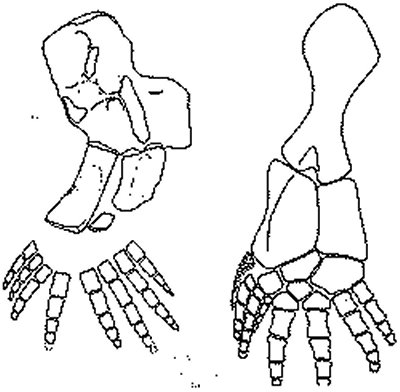
Nature, vol. 347, p. 67, 1990. | Forelimb of
Acanthostega (left) has eight digits. Hind limb of Ichthyostega (right) has seven
digits. |