|
GOULD--PRESIDENTIAL ADDRESS
|
325
|
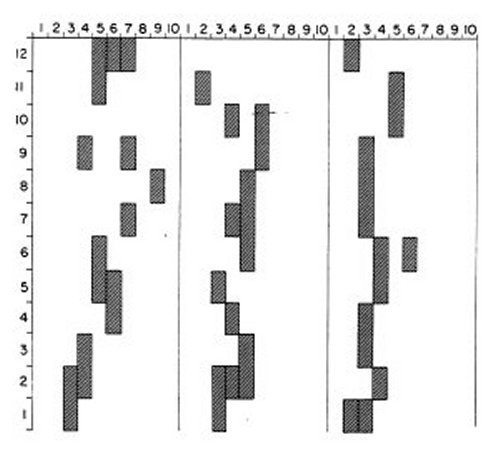
| | CRETACEOUS | PALEOGENE | NEOGENE |
FIGURE 6--Modal decades, as defined in text, for each
of the three radiations (Cretaceous in five-million-year intervals;
Paleogene and Neogene in three-million-year intervals). Except for an
initial rise in the Cretaceous, modal decades show no trend to increase.
in
the shallows as well, but subclades in these environments did not prevail. The
trend would then represent a decrease in variance-a differential removal of the
shallow water tail, not a retreat to abyssal safety. Symmetrical
trends.--For interesting psychological reasons, this category is not usually
read as a simple inverse of symmetrical increase trends. If an increase trend
spreads out symmetrically on both tails and alters no measure of central tendency,
we usually don't choose to speak of a trend at all, unless the extreme values
at one tail hold a particular fascination for us. This is why, as argued above
in the paradox of "life's little joke" (p. 321), we do not recognize
as trends the greatest success stories in mammalian evolution--the not clearly
directional explosions of species diversity in antelopes, rodents, and bats. But
symmetrical decrease trends around an unchanged mean do tend to catch our attention
for several reasons. On the other side of life's little joke, single survivors
are misread as termini of anagenetic trends--so we spin the classic tales
of horse and Homo.Each type of symmetrical decrease trend leads
readily to backward misinterpretation when we misfocus upon entities moving rather
than variance decreasing. Consider two examples: 1) when variance drops because
number of species plummets, we often think in terms of motion to an optimal form,
when the primary phenomenon is reduction (perhaps random or nonselective) to a
point of near extinction; 2) when the number of entities remains constant, but
variance drops by reducing disparity, we often lament for an intriguing, lost
extreme that seems to define some particular excellence--while reduced variance
really measures a beneficial stabilization of the system, and the valued extreme
was never a "thing" at all, but should have been read as an edge of
a system.Lest this claim seem overly abstract or improbable, I present |