|
GOULD-PRESIDENTIAL ADDRESS
|
327
|
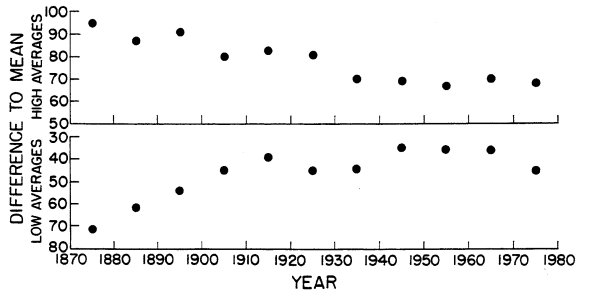
FIGURE 7 --
Symmetrical decrease of variation in batting averages to eliminate extreme
values at both tails of the distribution. Upper half: difference between
five highest averages and league mean averaged by decade. Lower half:
difference between average for five lowest hitters and league mean averaged
by decade.
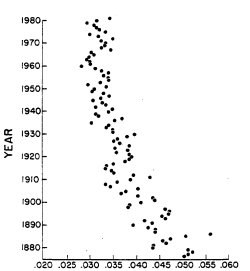 |
| STANDARD DEVIATION OF BATTING AVERAGES FOR REGULAR PLAYERS |
|
FIGURE 8
-- Standard deviation of batting averages for an full-time players
(two at bats or more per game) by year for the first hundred years
of professional baseball, both leagues. Note the regular decline.
|
that "winning" lineages survived for cause--in particular,
that they triumphed in the great Darwinian battle of competition under
the metaphor of the wedge. Mass extinction has been read as an unusual
stress that only the best designed could weather. The pattern of reduced
disparity with constant diversity has been seen as even better evidence
for success of anagenetic lineages in Darwinian struggle--for here
no externality of catastrophic environmental change interceded, and the
gradual disappearance of some must record the progressive triumph of others
(but see Benton, 1987).
An alternative--random plucking--provides an interpretation
more in accord with my theme that reduction in variance itself (not the
predictable virtues of winners) sets the character of trends. The Alvarez
hypothesis (Alvarez et al., 1980) has inspired a flood of suspicion that,
if extinctions are more rapid, profound, and unusual in their environmental
triggers than formerly recognized, then the loss of many groups may be
fundamentally nonselective (either truly random in the mathematical sense,
or at least fortuitous because features evolved for conventional selective
reasons in normal times happened, by exaptive good fortune, to enhance
survival in episodes of extraordinary stress). As for the Burgess oddballs,
no one (and not for lack of trying) has been able to suggest a shred of
evidence that losers were, in any sense, more anatomically inefficient
or ultraspecialized than survivors (Conway Morris, 1986). Wind back life's
tape to the Burgess (first erasing what actually came later), let it play
again, and this time a quite different cast might emerge. If the cast
lacked Pikaia, the first chordate, we might not be here--and
the world would be no worse.
The obvious objection to random plucking as an alternative to selective
success holds that we are trying to explain trends, not just any
old pattern--and that random removals should lead to a reestablished
fauna different (of course) in specifics but not in directional character
from the pre-extinction version. True |